

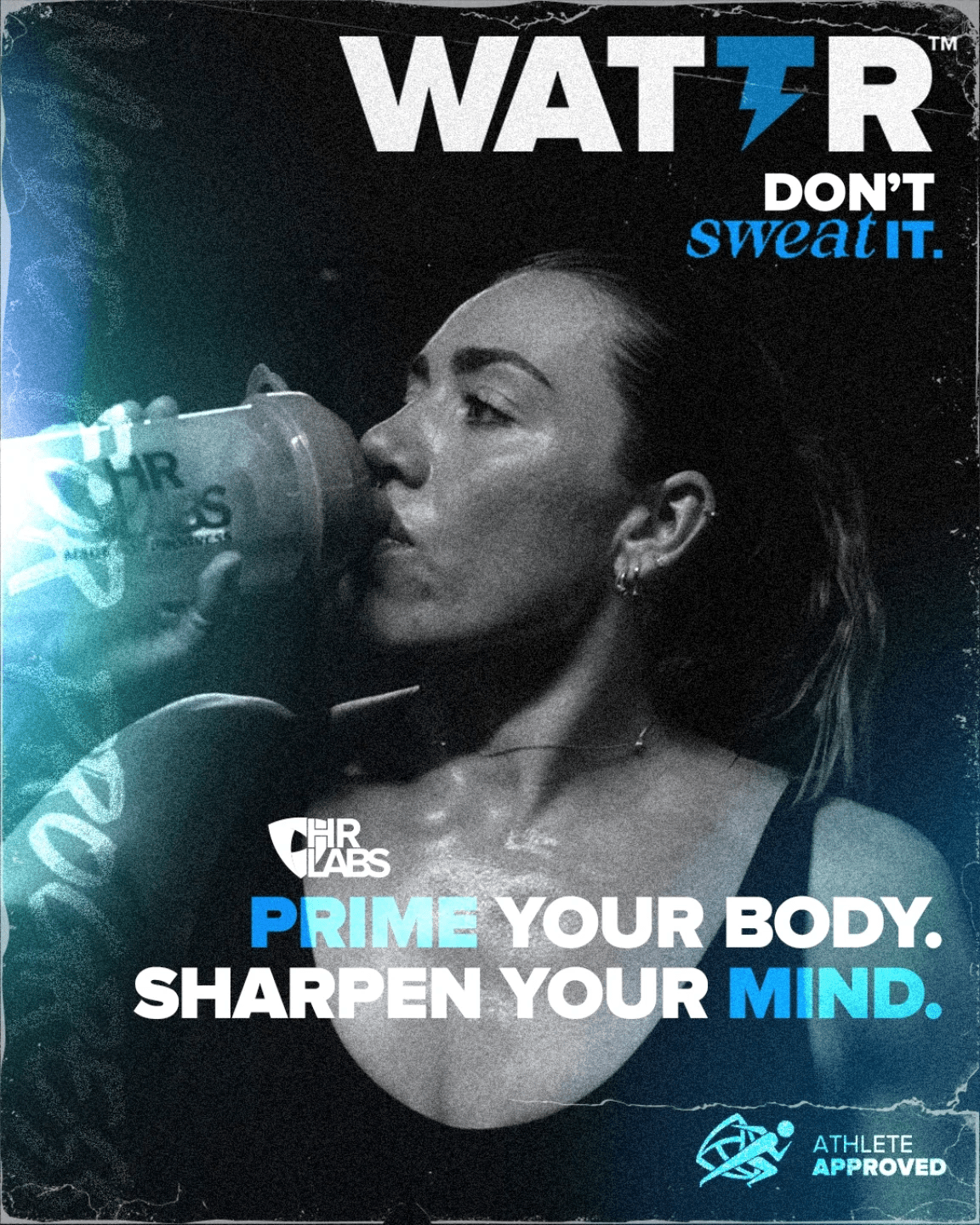
Athletic performance begins with the fundamentals. Training programs, nutritional fueling, proper hydration and micronutrient status. HR Labs WATTR™ was formulated to bolster hydration and micronutrient intake with a comprehensive approach that extends beyond replacing water and salt and has real on-the-day function.
What Makes WATTR™ Different?
Most hydration products focus exclusively on electrolyte replacement. WATTR™ takes a broader view, recognising that optimal cellular function during and after exercise requires multiple systems working in concert. The formulation combines four distinct functional categories:
Electrolytes for fluid balance: Sodium (235mg), potassium (358mg), magnesium (60mg), and calcium (80mg) to support proper hydration and mineral status.
Osmolytes for cellular hydration: Taurine (1500mg) to help cells maintain water content independent of electrolyte shifts.
Prebiotic fibre for gut health: Fructo-oligosaccharides (1000mg) to support short-chain fatty acid production and intestinal barrier integrity.
B vitamins for energy metabolism: Bioactive forms of B6 (pyridoxal-5'-phosphate)(25mg), B12 (methylcobalamin)(500mcg), and B9 (5-methyltetrahydrofolate)(200mcg) to support the increased metabolic demands of training.
Each category addresses a specific physiological requirement that becomes more important as training volume, intensity, or environmental stress increases.

The Electrolyte Foundation: When we want more than Water
Every litre of sweat carries dissolved electrolytes your body depends on for muscle contraction, nerve signaling, and fluid regulation. Sodium losses during exercise typically range from 200 to 2000mg per litre of sweat, with higher concentrations occurring during intense exercise when sweat glands cannot efficiently reabsorb sodium before it reaches the skin surface.[1]
The role of sodium in hydration is frequently misunderstood. During exercise, sodium supplementation provides minimal performance benefit until you reach extreme endurance contexts where total body stores become meaningfully depleted.[2] An average runner completing the Boston Marathon might lose approximately 4 grams of sodium, well within the body's natural buffering capacity of roughly 100 grams total sodium in an 80 kg individual.
Where sodium becomes critical is during rehydration. After exercise, drinking plain water dilutes blood sodium concentration, which paradoxically triggers increased urine output as your body attempts to restore normal sodium levels.[3] Drinking large volumes of plain water after heavy sweating can actually compromise rehydration efficiency. Beverages containing sodium improve fluid retention compared to plain water, with solutions containing 1.5 to 3.5 g/L sodium chloride providing a practical balance between palatability and effectiveness.[4]
Potassium, magnesium, and calcium serve many different roles in cellular function and recovery from training. Sweat losses of these minerals are relatively small compared to total body stores, but athletes training daily need consistent replenishment to maintain optimal function over time. Unlike sodium, these minerals do not require precise timing around workouts but should be viewed as targets across the entire day.
For the complete science on sweat composition, rehydration strategies, and when electrolytes matter most, see the electrolytes article.
Taurine: Cellular Hydration Beyond Electrolytes
Water regulation occurs at two levels: between blood and cells (managed primarily by electrolytes), and within cells themselves (managed by osmolytes). Taurine is the most abundant free amino acid in muscle tissue and serves as a crucial osmolyte, allowing cells to adjust their water content without disrupting the electrolyte concentrations required for normal cellular machinery.[5]
Cells maintain high taurine concentrations through a dedicated sodium-dependent transporter protein (TauT). Mice engineered without functional TauT genes retained only 2% of normal taurine content and showed reduced cell water volume, structural muscle defects, and significantly compromised exercise capacity.[6] Taurine is not simply beneficial, it is essential for proper cellular water regulation under the metabolic stress of exercise.
A meta-analysis of ten studies using doses from 1 to 6 grams daily found that taurine supplementation significantly improved endurance performance, with benefits observed from both single doses and continued use.[7]
WATTR™ provides 1500mg of taurine per serving, within the 1 to 2g range most commonly associated with exercise benefits in clinical literature.
For the complete mechanisms of taurine as an osmolyte and its role in cellular hydration, see the taurine article.
Fructo-Oligosaccharides: Gut Health Under Training Stress
Intense exercise redirects blood flow away from the gut. Circulation to internal organs can decrease by up to 70% during activity at 70% VO2max, causing intestinal stress that disrupts gut permeability and can allow bacterial toxins into circulation, driving inflammatory responses that compound training stress.[12]
Fructo-oligosaccharides (FOS) are selectively fermented by beneficial gut bacteria, particularly Bifidobacterium species, to produce short-chain fatty acids (SCFAs) including acetate, propionate, and butyrate. These SCFAs serve as the primary energy source for intestinal cells, support intestinal barrier integrity, and have anti-inflammatory effects both in the gut and systemically that may aid exercise recovery.[13]
Active B Vitamins: Supporting Increased Metabolic Demand
Exercise creates elevated demand for B vitamins through multiple pathways: metabolic turnover increases, protein metabolism accelerates, oxidative stress rises, and red blood cell production must keep pace with training adaptations.[8] For athletes training five or more sessions weekly, particularly those restricting energy intake, ensuring adequate B vitamin status becomes increasingly important.
Form matters significantly for B6, B9, and B12. Common supplemental forms (pyridoxine for B6, folic acid for B9, cyanocobalamin for B12) require conversion to their active forms before the body can use them. Genetic variants like MTHFR C677T, which affects up to 15% of the population, can substantially reduce conversion efficiency.[9] Research in soccer players found that athletes with the MTHFR TT genotype had significantly lower vitamin B9 levels and higher homocysteine concentrations, a marker of functional deficiency, compared to athletes with other genotypes.[10]
WATTR™ uses only bioactive forms that bypass these conversion steps:
- Pyridoxal-5'-phosphate (active B6)
- Methylcobalamin (active B12)
- Quatrefolic® 5-methyltetrahydrofolate (active B9)
These forms provide more reliable absorption and avoid the potential issues associated with high-dose supplementation of inactive precursors. Sustained high-dose pyridoxine can competitively inhibit the very enzymes that depend on active B6, potentially inducing functional deficiency symptoms even when blood levels appear adequate.[11]
For the full science on why athletes need more B vitamins and why active forms matter, see the B vitamins article.
AstraGin®: Improving Ingredient Uptake
AstraGin® (25mg): AstraGin® is a blend of astragalus and ginseng plant compounds that improves nutrient absorption. It works by supporting the health of gut wall cells and increasing the activity of nutrient transporters, the mechanisms that move ingredients from your gut into your bloodstream. In a hydration formula where the goal is efficient uptake of electrolytes, taurine, and B vitamins, improving absorption of each component contributes to overall effectiveness.
Practical Application: When to Use WATTR™
WATTR™ complements a normal healthy diet, it does not replace it. The product serves different purposes depending on your training context:
Short, moderate sessions in cool conditions: Focus on meeting daily electrolyte and vitamin needs across the whole day. WATTR™ contributes to this total, with its primary benefit being encouraging adequate fluid intake through improved palatability.
Prolonged or repeated exercise exceeding 90 minutes: The comprehensive electrolyte profile becomes more clearly beneficial here, particularly in warm conditions where sweat rates exceed 1.5 L/hour. The sodium content helps improve fluid retention during the extended rehydration period after training.
High training volume (10+ hours weekly): Athletes in this category face elevated B vitamin turnover and consistent mineral losses across multiple sessions. Daily WATTR™ consumption helps ensure adequate intake when dietary attention may be difficult to maintain.
Energy restriction periods: Cutting calories while maintaining training volume creates peak micronutrient demand alongside reduced food-based intake. This is when supplementation provides the clearest value.
Heat exposure or altitude training: Environmental stressors that increase both sweat rate and metabolic demand benefit from the combined electrolyte, osmolyte, and B vitamin support.
The rehydration target after significant fluid loss remains 1.25 to 1.5 L per kilogram of body weight lost. How much sodium you use alongside this will be very personal according to dietary intake and palatability, but if you want to add more to your 220mg included in WATTR™ to further improve on rehydration efficiency you can consider sodium content up to 3.3 g/L as an evidence based addition.
MADE FOR PROGRESS

References
- Baker LB, De Chavez PJD, Ungaro CT, et al. Exercise intensity effects on total sweat electrolyte losses and regional vs. whole body sweat [Na+], [Cl-], and [K+]. Eur J Appl Physiol. 2019;119(2):361-375.
- Baker LB. Sweating rate and sweat sodium concentration in athletes: a review of methodology and intra/interindividual variability. Sports Med. 2017;47(Suppl 1):111-128.
- McCartney D, Desbrow B, Irwin C. The effect of fluid intake following dehydration on subsequent athletic and cognitive performance: a systematic review and meta-analysis. Sports Med Open. 2017;3(1):13.
- Shirreffs SM, Maughan RJ. Volume repletion after exercise-induced volume depletion in humans: replacement of water and sodium losses. Am J Physiol. 1998;274(5):F868-75.
- Pasantes-Morales H. Taurine homeostasis and volume control. Adv Neurobiol. 2017;16:33-53.
- Warskulat U, Heller-Stilb B, Oermann E, et al. Phenotype of the taurine transporter knockout mouse. Methods Enzymol. 2007;428:439-458.
- Waldron M, Patterson SD, Tallent J, Jeffries O. The effects of an oral taurine dose and supplementation period on endurance exercise performance in humans: a meta-analysis. Sports Med. 2018;48(5):1247-1253.
- Woolf K, Manore MM. B vitamins and exercise: does exercise alter requirements? Int J Sport Nutr Exerc Metab. 2006;16(5):453-484.
- Curro M, Di Mauro D, Bruschetta D, et al. Influence of MTHFR polymorphisms on cardiovascular risk markers in elite athletes. Clin Biochem. 2015;49(1-2):183-185.
- Dinc N, Yucel SB, Taneli F, Sayin MV. The effect of the MTHFR C677T mutation on athletic performance and the homocysteine level of soccer players and sedentary individuals. J Hum Kinet. 2016;51:61-69.
- Bisello G, Longo C, Rossignoli G, Phillips RS, Bertoldi M. Oxygen reactivity with pyridoxal 5' phosphate enzymes: biochemical implications and functional relevance. Amino Acids. 2020;52(8):1089-1105.
- Costa RJS, Snipe RMJ, Kitic CM, Gibson PR. Systematic review: exercise-induced gastrointestinal syndrome, implications for health and intestinal disease. Aliment Pharmacol Ther. 2017;46(3):246-265.
- Bongiovanni T, Yin MOL, Heaney LM. The athlete and gut microbiome: short-chain fatty acids as potential ergogenic aids for exercise and training. Int J Sports Med. 2021;42(13):1143-1158.
FOUND THIS HELPFUL?
This content is for educational purposes only and does not intend to cure or diagnose disease, nor make any health claims. There is no intent to slander in any way, but rather produce an informed and accurate third party perspective on the product. Always consult your accredited medical professional before introducing a new supplement. This content is not to be copied or repurposed in any form without express permission from the author.
First published for HRLABS.co.uk 7th February 2026
The Science of B Vitamins for Energy, Recovery, and Why Athletes Need More
How Sabroxy® Supports Focus and Brain Health Under Training Fatigue