

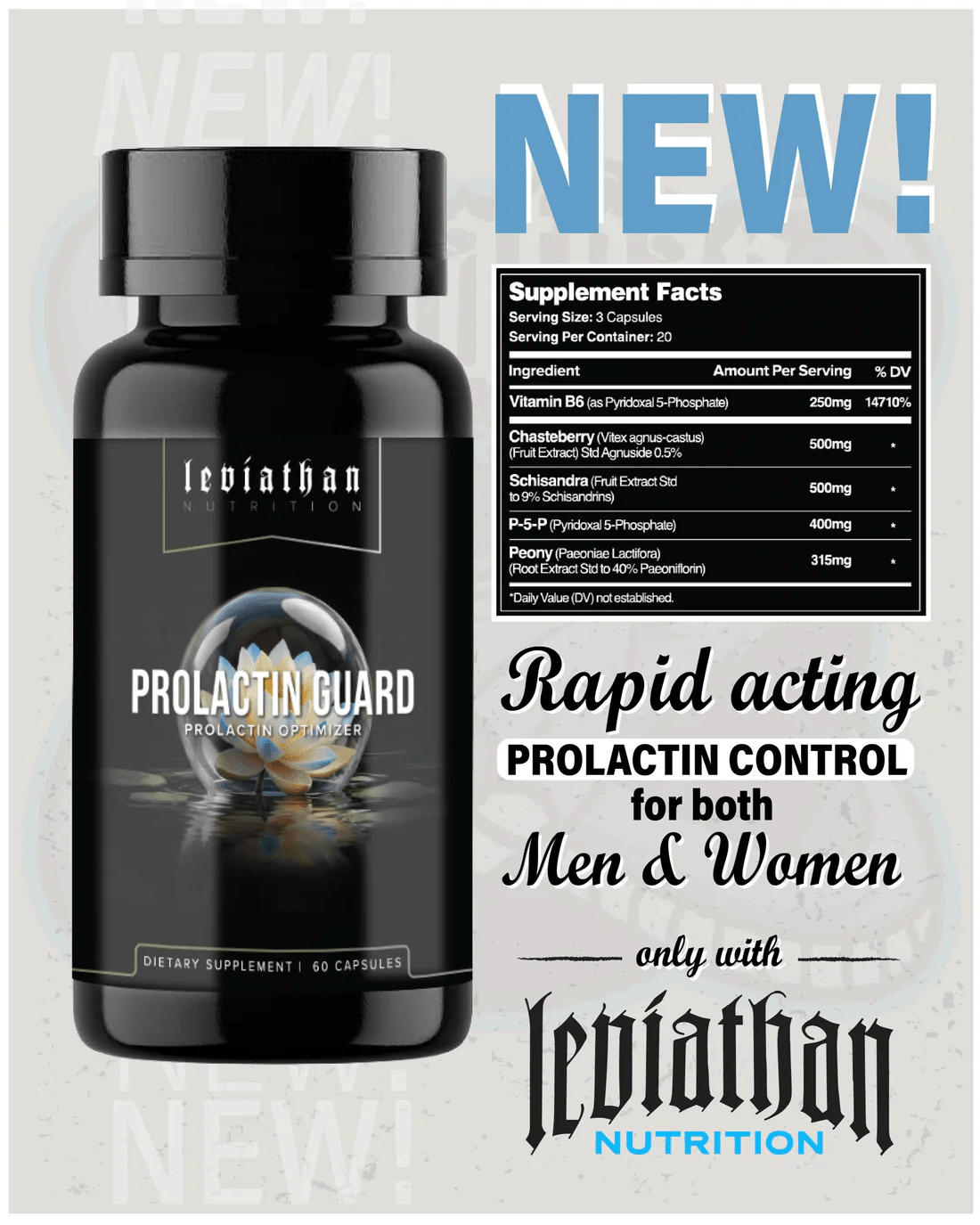
Prolactin Guard is Leviathan Nutrition's natural prolactin support supplement for men and women. The formula targets four independent pathways that regulate prolactin release in the pituitary, so the result holds even when a single mechanism is blunted. This article walks through the ingredients, the mechanisms, and the reasoning behind every dose on the label.

WHAT CAUSES HIGH PROLACTIN?
Prolactin is unusual among pituitary hormones in that the cells that secrete it (lactotrophs) release prolactin spontaneously. Almost all regulation happens through inhibition rather than stimulation.
- The dominant inhibitor is dopamine, delivered to the pituitary through a short portal-vein loop from the hypothalamus.
- The dominant upregulator is estradiol, which proliferates lactotrophs and increases the prolactin each cell secretes over a period of weeks.
WHAT CAUSES HIGH PROLACTIN IN WOMEN?
In women the most common drivers of high prolactin are cyclical hormonal shifts, PMS-driven prolactin spikes, post-pill rebound, and stress-related dopamine disruption. Symptoms include cyclical breast pain (mastalgia), irregular cycles, low libido, mood disturbance, and in some cases fertility complications.
WHAT CAUSES HIGH PROLACTIN IN MEN?
In men the dominant driver is the estrogen-lactotroph axis, particularly in those on TRT or PED protocols. Supra-physiological testosterone aromatises to estradiol, which proliferates prolactin-secreting cells over weeks. Sleep disruption, chronic training stress, and lifestyle factors also push milder prolactin elevations. Symptoms include low libido, weak erections, nipple sensitivity, mood flatness, and stalled training progress.
An intervention that only pulls one lever often results in non-responder groups as is well shown in the literature for both pharmaceutical and supplemental compounds. Prolactin Guard pulls four complimentary actions, not just one.
PROLACTIN GUARD INGREDIENTS AND DOSING
Each bottle of Prolactin Guard contains 60 capsules. Each three-capsule serve includes:
- Pyridoxal-5-Phosphate (P5P) (400mg)
- Chasteberry, Vitex agnus-castus (std. 0.5% agnuside) (500mg)
- Schisandra Fruit Extract (std. 9% schisandrins) (500mg)
- Peony Root Extract, Paeoniae lactiflora (std. 40% paeoniflorin) (315mg)
Dose matches the strength of the prolactin driver, not the user's sex.
- 1 - 2 capsules daily is the starting point for milder elevation: cyclical hyperprolactinemia in women, and mild prolactin elevation in men driven by sleep disruption, training stress, or lifestyle factors.
- 3 capsules daily, split between waking and lunch, is reserved for strong drivers: PED and anabolic use, TRT with significant aromatisation, and severe hyperprolactinemia in either sex.
Evening dosing should be avoided in either case because the dopaminergic load disrupts sleep onset.

HOW TO LOWER PROLACTIN NATURALLY
HOW P5P AND VITEX LOWER PROLACTIN THROUGH DOPAMINE
The fastest, most direct way to suppress prolactin is to increase dopamine activity at the pituitary D2 receptor. Prolactin Guard does this with two complementary actives.
Pyridoxal-5-Phosphate (P5P) at 400mg drives dopamine synthesis upstream. P5P upregulates the aromatic L-amino acid decarboxylase (AADC) enzyme in the hypothalamus, which converts L-DOPA into dopamine. The dopamine then travels through the portal vein directly to the pituitary, where it suppresses prolactin release. Clinical work with P5P at 300mg and above has shown mean prolactin reductions approaching 50% in hyperprolactinemic populations.1,2 A secondary effect is direct inhibition of prolactin secretion at the lactotroph cell membrane, and a long-term effect is downregulation of the antiapoptosis gene Bcl-2, which accelerates turnover of the cells that produce prolactin.3
Chasteberry (Vitex) at 500mg delivers diterpene clerodadienols, which act as direct D2 receptor agonists at the pituitary. This is the same receptor that cabergoline targets, just with a far gentler activation profile and no affinity for the cardiac 5-HT2B receptor that drives valve fibrosis. Vitex has the strongest clinical evidence base in women, where multiple placebo-controlled trials show reliable suppression of cyclical hyperprolactinemia and mastalgia at relatively low doses.4,5,6 In men the dose response is biphasic: low doses can paradoxically raise prolactin, with higher doses reliably producing suppression7 The 500mg in Prolactin Guard sits in the effective range for both audiences.
HOW PEONY AND SCHISANDRA LOWER PROLACTIN WITHOUT DOPAMINE
Dopamine is the dominant prolactin lever, but it is not the only one. Two further mechanisms operate independently and become important when the dopaminergic system is impaired by chronic stress, dopamine receptor downregulation follows.
Peony root standardised to 40% paeoniflorin at 315mg activates the membrane progesterone receptor alpha (mPRα) on lactotroph cells. mPRα activation triggers TGFβ1 signalling, which acutely inhibits prolactin release and over time reduces lactotroph proliferation. This is the same end-point that dopamine reaches through a different door. In animal models paeoniflorin produces clear prolactin reductions independent of dopamine signalling, which makes peony the formula's insurance policy against dopaminergic failure.8,9,10 Peony has a long traditional record in women's hormonal medicine for the same reason.
Schisandra fruit extract at 500mg acts higher up the feedback loop. The schisandrins, particularly schisandrin B, upregulate prolactin receptor expression on the TIDA dopamine neurons in the hypothalamus. The result is a more sensitive feedback signal: when prolactin rises, the hypothalamus detects it sooner and releases more dopamine in response.11 Schisandra strengthens the system's own correction mechanism rather than overriding it.
WHY P5P AND NOT REGULAR VITAMIN B6
Most cheap B6 supplements use pyridoxine HCl. At the doses needed for prolactin control (200mg to 600mg daily), pyridoxine HCl causes peripheral sensory neuropathy. Damage to nerve tissue.12 The mechanism is mechanical: high circulating pyridoxine competitively inhibits pyridoxal kinase, the enzyme that converts pyridoxine into its active P5P form. The result is functional B6 deficiency in nerve tissue despite high serum B6 levels, which leads to reduced GABA neurotransmission and over-stimulation damage to sensory neurons. Cases of neuropathy have been documented at intakes as low as 50mg to 100mg per day in chronic use.
Prolactin Guard uses P5P directly. It is already the active coenzyme form, so it bypasses the conversion step entirely and carries no neuropathy signal at the doses required for prolactin control.
WHY NO MUCUNA OR L-DOPA
L-DOPA, the active compound in Mucuna pruriens (velvet bean), is the obvious shortcut for a dopamine-based prolactin formula. It is also the wrong tool. L-DOPA is rapidly converted to dopamine by AADC in peripheral tissues (outside the brain) before it reaches the pituitary, which causes nausea and vomiting at any dose strong enough to move prolactin meaningfully. The P5P in Prolactin Guard up-regulates the same peripheral AADC enzyme, which would make the L-DOPA problem worse if the two were stacked. Sustained dopaminergic activity at the pituitary requires endogenous dopamine production, not oral L-DOPA loading.
PROLACTIN GUARD VERSUS CABERGOLINE
Cabergoline is a potent D2 receptor agonist and the gold standard prescription option for hyperprolactinemia. It is also a 5-HT2B serotonin receptor agonist, and the 5-HT2B receptor is expressed on cardiac valve tissue. Chronic activation drives fibrotic remodelling, valve thickening and heart failure. The FDA label for cabergoline explicitly warns against use in patients with cardiac or extracardiac fibrotic disorders.
The bodybuilding and TRT population already runs elevated cardiovascular risk through blood pressure, hematocrit, training load and androgen exposure, which makes cabergoline a poor long-term fit. Women using cabergoline for cyclical or fertility-related prolactin issues face the same cardiac risk profile.
Prolactin Guard targets the same D2 receptor through Vitex without 5-HT2B affinity, and supplements that suppression with P5P, paeoniflorin and Schisandra dopaminergic actions. The mechanistic synergy means a single high-dose hit on the D2 receptor is not required for the formula to work.
HOW LONG DOES IT TAKE TO LOWER PROLACTIN?
P5P and Vitex are documented to shift related dopamine activity and prolactin within days, so the libido, mood and cyclical-symptom markers respond first. The paeoniflorin and Schisandra mechanisms build over weeks as lactotroph turnover catches up with the new signalling environment. Re-test bloodwork after finishing your first bottle to see the full picture, and adjust the dose down if prolactin trends below the lower reference range.
KEEN TO TRY PROLACTIN GUARD?

Leviathan Prolactin Guard is available now from Strom Sports New Zealand, with same-day dispatch to all NZ and Australian addresses on orders placed before 11AM NZT.
https://stromsports.co.nz/products/leviathan-prolactin-guard
PROLACTIN GUARD FAQ
What is Leviathan Prolactin Guard?
Prolactin Guard is a natural prolactin support supplement built around 400mg pyridoxal-5'-phosphate (P5P), 500mg Vitex, 500mg Schisandra and 315mg Peony root standardised to 40% paeoniflorin. The formula targets four independent pathways that govern prolactin release in the pituitary, so the result holds even when a single mechanism is blunted.
What causes high prolactin in men?
The two common drivers are dopamine deficits at the pituitary D2 receptors and chronically elevated estrogen, which proliferates the cells that secrete prolactin. TRT, anabolic steroid use, stress, and certain medications all push these levers. Pituitary microadenomas are a rarer cause and need bloodwork plus imaging to diagnose.
What are the symptoms of high prolactin?
Low libido, weak erections, mood flatness, stalled muscle gain, nipple sensitivity or discharge, and gynecomastia development. Symptoms often appear before serum prolactin clears the lab reference range, especially in TRT users running supra-physiological testosterone.
Who is Prolactin Guard for?
Men on TRT or PED protocols who want to reduce or replace cabergoline and bromocriptine. Hormone optimisers managing high prolactin without a prescription. Anyone whose bloodwork shows prolactin above the male reference range (2.0–18.0 ng/mL) or symptomatic elevation within the female reference range (3.0–25.0 ng/mL).
How do I take Prolactin Guard?
Dose matches the strength of the prolactin driver, not your sex. One capsule daily is the starting point for milder elevation: cyclical hyperprolactinemia in women, or mild elevation in men from sleep disruption, training stress or lifestyle factors. Three capsules daily, split between waking and lunch, is reserved for strong drivers like PED use, TRT with significant aromatisation, or severe hyperprolactinemia.
How long until Prolactin Guard works?
P5P and Vitex shift dopamine activity within days. The paeoniflorin and Schisandra mechanisms build over weeks as lactotroph turnover catches up. Re-test bloodwork after finishing your first bottle for the clearest readout.
Why does Prolactin Guard use P5P instead of regular Vitamin B6 (pyridoxine)?
Pyridoxine HCl, the cheap form of B6 in most supplements, competitively blocks the enzyme that activates it into P5P. At the 200–600mg daily range needed for prolactin control, pyridoxine causes peripheral sensory neuropathy. P5P is already the active coenzyme, so it bypasses the conversion bottleneck and the nerve damage risk entirely.
Why is there no Mucuna or L-DOPA in Prolactin Guard?
L-DOPA converts to dopamine in the gut before it reaches the pituitary, which causes nausea and vomiting at any dose strong enough to move prolactin. The P5P in Prolactin Guard would make this worse by upregulating the same peripheral conversion enzyme. Prolactin Guard uses sustained dopaminergic action at the pituitary instead.
How does Prolactin Guard compare to cabergoline?
Cabergoline agonises the 5-HT2B serotonin receptor on cardiac tissue, which drives heart valve fibrosis. The FDA label warns against use in anyone with cardiac or fibrotic history. Prolactin Guard works through different receptors and carries no fibrotic signal.
Will Prolactin Guard help with gynecomastia, low libido or mood from high prolactin?
If the symptoms trace back to elevated prolactin, lowering prolactin removes the driver. Gynecomastia development tracks both prolactin and estrogen, so men with both high also need estrogen support. Libido and mood respond fastest because the dopamine system shifts within the first week.
Can women take Prolactin Guard?
Yes. Vitex has the strongest female evidence base for cyclical hyperprolactinemia and mastalgia. Women generally start at one capsule daily because the Vitex dose response in female physiology favours strong suppression at lower intakes than men.
Is Prolactin Guard available in New Zealand and Australia?
Yes. Prolactin Guard ships from Strom Sports New Zealand to all NZ and Australian addresses, with same-day dispatch on orders placed before 11AM NZT.
REFERENCES
- Delitala G, Masala A, Alagna S, Devilla L. Effect of pyridoxine on human hypophyseal trophic hormone release: a possible stimulation of hypothalamic dopaminergic pathway. Effect of vitamin B6 on the serum concentration of pituitary hormones in normal humans and under pathologic conditions (1979).
- Moretti C, Fabbri A, Gnessi L, et al. Pyridoxine (B6) Suppresses the Rise in Prolactin and Increases the Rise in Growth Hormone Induced by Exercise (1982).
- Renner U, Pagotto U, Arzberger T, Stalla GK. Pyridoxal Phosphate Inhibits Pituitary Cell Proliferation And Hormone Secretion (2006).
- Halaska M, Beles P, Gorkow C, Sieder C. Treatment of cyclical mastalgia with a solution containing a Vitex agnus castus extract: results of a placebo-controlled double-blind study (1999).
- Kilicdag EB, Tarim E, Bagis T, et al. Fructus agni casti and bromocriptine for treatment of hyperprolactinemia and mastalgia (2004). Int J Gynaecol Obstet.
- Niroumand MC, Heydarpour F, Farzaei MH. Pharmacological and therapeutic effects of Vitex agnus-castus L.: a review. Vitex agnus castus effects on hyperprolactinaemia (2023, Systematic Review).
- Merz PG, Gorkow C, Schrödter A, et al. The effects of a special Agnus castus extract (BP1095E1) on prolactin secretion in healthy male subjects (1996/2009).
- Wang QS, Cui YL, Dong TJ, Zhang XF, Lin KM. Paeoniflorin and liquiritin, two major constituents in Chinese herbal formulas used to treat hyperprolactinemia-associated disorders, inhibit prolactin secretion in prolactinoma cells by different mechanisms (2017).
- Huang Y, Wang Y, Wei X, et al. Paeoniflorin ameliorates antipsychotic-induced hyperprolactinemia in rats by attenuating impairment of the dopamine D2 receptor and TGF-β1 signaling pathways in the hypothalamus and pituitary (2020).
- Huang Y, et al. Paeoniflorin attenuates hyperprolactinemia by targeting the pituitary mPRα-mediated, dopamine receptor-independent signaling in vivo and in vitro (2025). https://www.sciencedirect.com/science/article/abs/pii/S0041008X25003278
- Park HJ, Choi YJ, Lee JH, Nam MJ. Therapeutic effects of Schisandra chinensis on the hyperprolactinemia in rat (2017).
- Vrolijk MF, Opperhuizen A, Jansen EHJM, Hageman GJ, Bast A, Haenen GRMM. The vitamin B6 paradox: Supplementation with high concentrations of pyridoxine leads to decreased vitamin B6 function. Toxicol In Vitro (2017).
- U.S. Food and Drug Administration. DOSTINEX (cabergoline) Prescribing Information. Pfizer, 2011. https://www.accessdata.fda.gov/drugsatfda_docs/label/2011/020664s011lbl.pdf
FOUND THIS HELPFUL?
This content is for educational purposes only and does not intend to cure or diagnose disease, nor make any health claims. There is no intent to slander in any way, but rather produce an informed and accurate third party perspective on the product. Always consult your accredited medical professional before introducing a new supplement. This content is not to be copied or repurposed in any form without express permission from the author.
First published to stromsports.co.nz on 15th of May 2026
Co-Crystal Curcumin Explained: Faster, Higher Absorption