

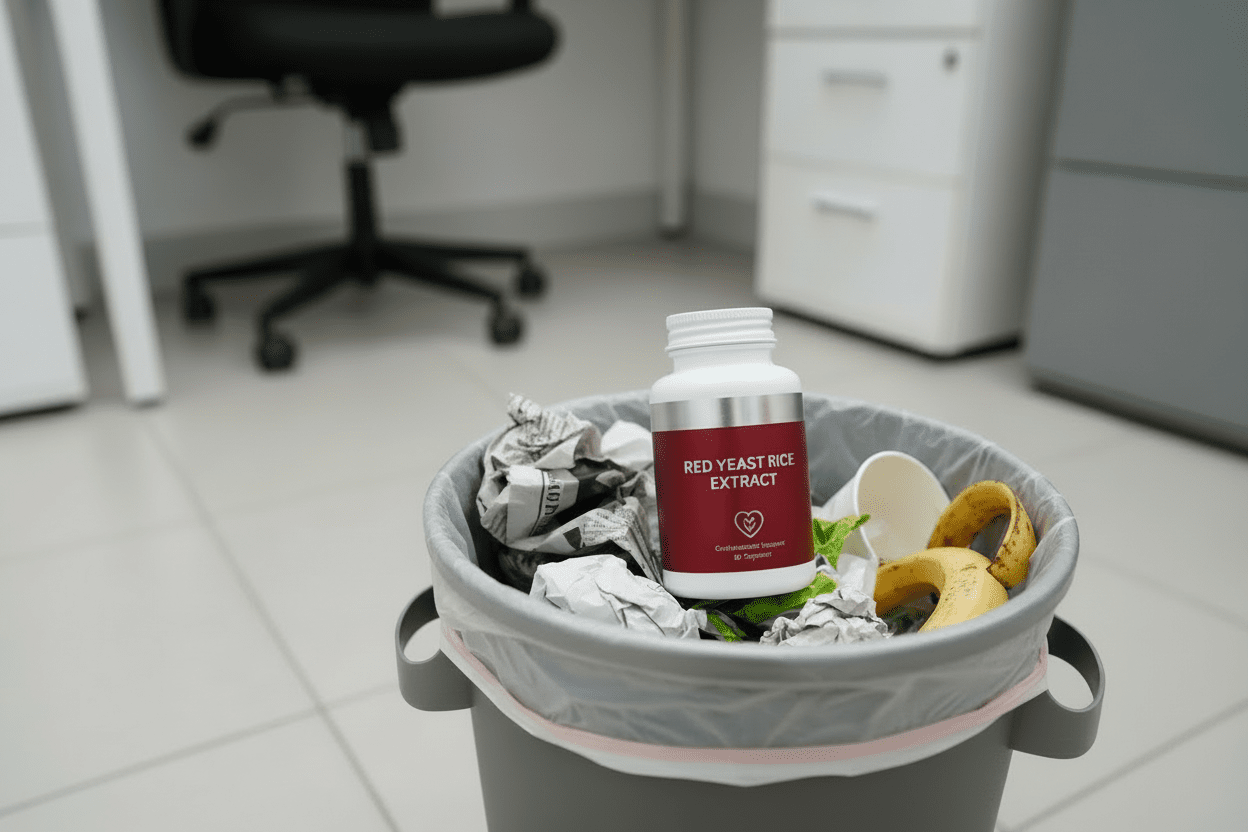
Red yeast rice (RYR) has been back on trend down our side of the world. It's not the first time and I'm sure it will fall off again, but does feel like it has had a lot more attention late-2025 / early-2026 than previous hype cycles.
Read Yeast Rice contains monacolin K – a compound identical to the well-studied and effective drug Lovastatin that is prescribed by your doctor for high cholesterol.
So why don't we stock it? Surely that means it's effective right?
RYR has four key problems that make too unreliable to recommend, especially given better alternatives are available. Here's the hot notes.
1. What's on the label doesn't give an idea of effective active ingredients
Independent testing of commercial RYR products shows massive variation in actual monacolin K content. One study found a 40-times difference in monacolin K between products that use the same quantity of RYR – meaning two supplements with the same label will likely deliver vastly different doses. In other words, for some products one capsule would provide the same dose as 40 capsules of another.
Some products contained essentially nothing. The most potent delivered amounts comparable to low-dose prescription statins (~10mg). This makes recommending dosing in a evidence based manner nearly impossible without trusted third-party testing.
2. Absorption varies wildly between products
Even if two RYR products contain the same amount of monacolin K, your body may absorb very different amounts.
Absorption depends heavily the polyphenols and triterpenes also present in the extract. Products with higher levels of these compounds showed significantly better absorption (up to 95% recovery in digestion tests). Products with depleted or stripped-down extracts absorbed poorly.
The problem? Most labels don't list polyphenol or triterpene content. So there's no way to know the effective potency even if monocolin K content is known. Like point 1, we can't reliably predict an effective dose as a result.
3. Citrinin contamination is not rare, but a normal part of RYR
RYR is made by fermenting rice with a specific mould. Unfortunately, this process can also produce citrinin – a documented toxin that damages the kidneys and other organs at the doses you'll find in RYR.
A 2021 European study tested 37 RYR supplements. Every single product contained citrinin. Only one met the EU safety limit of 100 µg/kg, and the content ranged all the way up to 25,100µg/kg. This included four products labelled "citrinin-free" which also tested positive for contamination. New Zealand and Australia have no regulation regarding citrinin, not from lack of concern - but rather lack of action.
4. At effective doses, you have the same side effects as prescription Lovastatin
Clinical trials show RYR can lower LDL cholesterol – but generally at doses providing similar amounts of monacolin K as you would get from prescription Lovastatin.
One of the big reasons I get told folk are using RYR is because "I don't want to use statins because I know it has side effects".
It's true, at higher dose ranges statins do have a very unfavourable side effect profile, especially for those hard training regarding risk of CoQ10 depletion and consequential rhabdomyolysis (unmanageable muscle breakdown). RYR extract's function is by the exact same pathway, so will require the same level of activation on the statin-related pathway as lovastatin (search "HMG-CoA reductase inhibition"). Hence there is no meaningful reduction in side effect profile, most commonly the reason people get less side effects is because they're unknowing taking a lower dose of monacolin K.
Take-home actions you can take
If you have elevated cholesterol and want to use monacolin K, just get it from your doctor for the cost of a checkup and a tiny $5 prescription fee. I have no love for Big Pharma, but in this one-on-one comparison Lovastatin is the clear answer.
If you are concerned about side effects (rightly so), ensure you are using a low-dose - an approach you can discuss with your doctor and many are very on board with. Taking CoQ10 alongside is also standard medical recommendation in more progressive countries, another point to discuss with your doctor.
Personally, we prefer alternative approaches; those such as Pauling Therapy, Citrus Bergamot, and solving root problems such as insulin sensitivity. With Leviathan IRE or our Strom LipidMAX we've seen these are effective in real life bloodwork improvements within 1-2 months.
Want to do more reading?
Rigillo G, et al. (2024). Red Yeast Rice or Lovastatin? A Comparative Evaluation of Safety and Efficacy. Phytotherapy Research 39(1):264-281. DOI: 10.1002/ptr.8371
Righetti L, et al. (2021). Risk Assessment of RYR Food Supplements: Perception vs. Reality. Frontiers in Nutrition 8:792529. DOI: 10.3389/fnut.2021.792529
Avula B, et al. (2014). Chemical profiling and quantification of monacolins and citrinin in red yeast rice. Journal of Pharmaceutical and Biomedical Analysis 100:243-253. DOI: 10.1016/j.jpba.2014.07.039
FOUND THIS HELPFUL?
This content is for educational purposes only and does not intend to cure or diagnose disease, nor make any health claims. There is no intent to slander in any way, but rather produce an informed and accurate third party perspective on the product. Always consult your accredited medical professional before introducing a new supplement. This content is not to be copied or repurposed in any form without express permission from the author.
This article was written for and first published to stromsports.co.nz on 21.01.2026
Why Uridine Monophosphate Matters for Mental Performance in Sport
The Science of Taurine as an Osmolyte - Cellular Hydration from the Inside Out